
Sizing
Shipping box sizes: a size chart built around USPS price tiers
October 13, 20269 min readWritten by the BoxCrisp team
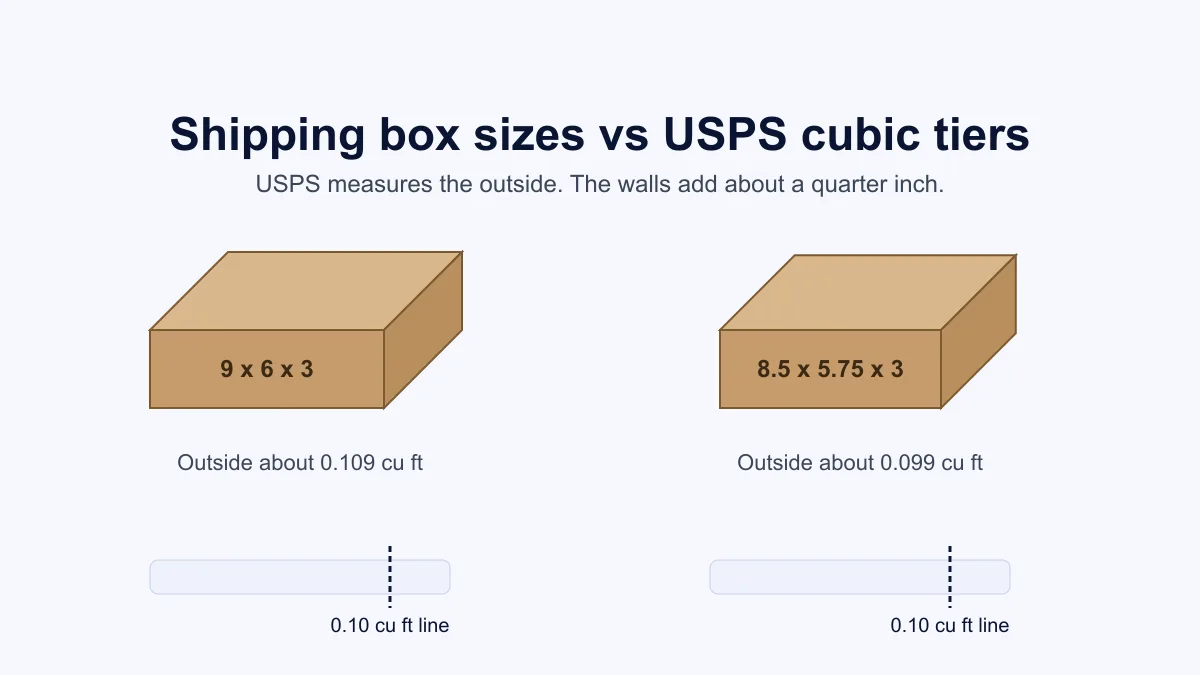

The best shipping box sizes are the ones that fit your product with a little padding and stay under a carrier price line once the box itself is measured. For small parcels sent by USPS Priority Mail Cubic, those lines sit every tenth of a cubic foot, and a box that looks right on paper, like a 9 x 6 x 3 inch shipper, can cross one because the board adds a little to every side.
Below is a shipping box size chart worked out from those tiers, what each size costs from us at 100, 250, 500, and 1,000 boxes, how to measure your own, and the one-quarter inch that can move your postage.
Why shipping box sizes and postage are tied together
Most small brands ship through software like Pirate Ship, Shippo, or ShipStation, and that software can buy Priority Mail Cubic. Cubic doesn't price a parcel on weight. It prices it on the space the box takes up, in five tiers.
The rules come straight from the USPS Domestic Mail Manual (opens in a new tab): a cubic parcel "must measure .50 cubic foot or less, weigh 20 pounds or less, and the longest dimension must not exceed 22 inches." Each measurement is rounded down to the nearest quarter inch, then length times width times height is divided by 1,728 to get cubic feet.
So a heavy little box, like a candle, a bag of coffee, or a set of supplements, can ship for the price of its size rather than its weight. That's the whole reason box size matters more than most people expect for parcels under half a cubic foot.
Above one cubic foot, it's a different game. Carriers start charging dimensional weight, and our guide to dimensional weight explains how that bill is worked out.
The USPS cubic tiers in plain numbers
| Tier | Cubic feet | Cubic inches, outside |
|---|---|---|
| 0.10 | Up to 0.10 | Up to 172.8 |
| 0.20 | Over 0.10 to 0.20 | Up to 345.6 |
| 0.30 | Over 0.20 to 0.30 | Up to 518.4 |
| 0.40 | Over 0.30 to 0.40 | Up to 691.2 |
| 0.50 | Over 0.40 to 0.50 | Up to 864 |
The column that trips people up is the last one. USPS measures the box as it arrives at the counter, which means the outside. Your box is made to fit your product, which means the inside.
Inside size vs outside size
A corrugated shipping box is a little bigger outside than inside, because the walls have thickness. For planning, add about a quarter inch to each inside dimension, then confirm the real outside size on your proof.
That small gap is where a tier slips. Take the 9 x 6 x 3 inch box, a size you will find in almost every stock catalog.
- Inside: 9 x 6 x 3 inches is 162 cubic inches, comfortably inside the 0.10 tier.
- Outside: about 9.25 x 6.25 x 3.25 inches, or roughly 188 cubic inches. That's over 172.8, so it rates in the 0.20 tier.
Trim the inside to 8.5 x 5.75 x 3 inches, and the outside comes to about 8.75 x 6 x 3.25, roughly 171 cubic inches. Back under the line. If your product fits that box, every parcel you send rates one tier lower.
Measure your shipping box size from the product out, then check the outside size against the tier line. A box that clears the line by a hair on the inside can miss it once the walls are counted.
Shipping box size chart, with real prices
These are kraft shipping boxes printed in one color, our most common shipper, priced on the exact inside dimensions shown. The tier column uses an outside size a quarter inch larger on each side.
| Inside size (L x W x D) | Outside, cubic ft | USPS cubic tier | At 100 | At 250 | At 500 | At 1,000 |
|---|---|---|---|---|---|---|
| 5.5 x 5.5 x 4.75 in | 0.096 | 0.10 | $1.72 | $1.09 | $0.77 | $0.72 |
| 8.5 x 5.75 x 3 in | 0.099 | 0.10 | $1.79 | $1.13 | $0.80 | $0.75 |
| 9 x 6 x 3 in | 0.109 | 0.20 | $1.85 | $1.17 | $0.83 | $0.77 |
| 6 x 6 x 6 in | 0.141 | 0.20 | $1.92 | $1.21 | $0.86 | $0.80 |
| 9.75 x 7.75 x 5.75 in | 0.278 | 0.30 | $2.46 | $1.55 | $1.10 | $1.02 |
| 10 x 8 x 6 in | 0.306 | 0.40 | $2.55 | $1.61 | $1.14 | $1.06 |
| 13.75 x 9.75 x 5.75 in | 0.486 | 0.50 | $3.19 | $2.01 | $1.42 | $1.33 |
| 12 x 12 x 12 in | 1.064 | Not cubic | $4.46 | $2.82 | $2.00 | $1.86 |
Look at the pairs. A 10 x 8 x 6 inch box lands just over 0.30 cubic feet outside, so it rates in the 0.40 tier. Shave a quarter inch off each side, to 9.75 x 7.75 x 5.75, and it drops to 0.30. The box also gets 9 cents cheaper at 250, so you save twice.
The same thing happens at the top. A 14 x 10 x 6 inch box measures past half a cubic foot outside and can't use cubic at all, while 13.75 x 9.75 x 5.75 stays inside the 0.50 tier.
Which shipping box size for which product
Start from what goes inside, then pick the smallest box above it.
- Small, heavy items such as a candle in a jar, a jar of skincare, or a bag of beans sit happily in a 5.5 x 5.5 x 4.75 inch box. For a parcel like that, paying for space rather than weight is usually the better deal. Our coffee shipping boxes page prices that kind of order.
- Flat goods like a folded tee, a book, or a set of cards suit 8.5 x 5.75 x 3 inches. If your product is that slim and goes out every day, a mailer box can be a nicer unboxing, and the comparison guide explains when each one wins.
- Two or three items together usually need 9.75 x 7.75 x 5.75 inches, still in the 0.30 tier.
- Electronics and accessories with an insert tend to land around 13.75 x 9.75 x 5.75 inches. The electronics shipping boxes page shows that format with an insert in mind.
- A one-foot cube is for bulky, light goods. It's past the cubic limit, so the dimensional weight rules apply.
If you're still choosing between sizes for a mailer rather than a shipper, our custom mailer box sizes chart covers those, and gift box sizes cover boxes that go out inside another carton.
How to find your own shipping box size
- Measure the product at its widest points. Length, width, and depth, in inches. Our guide on how to measure a box shows which side counts as which.
- Add padding. About a quarter inch on each side for something rigid that won't move, and half an inch to an inch for something fragile wrapped in paper or bubble.
- Add any insert. A fitted box insert takes up room too, so measure the product sitting in it.
- Work out the outside. Add about a quarter inch to each inside dimension.
- Check the tier. Multiply the outside length, width, and height, then divide by 1,728. If you're a few cubic inches over a line, see whether trimming a quarter inch somewhere still fits the product.
- Price it. Type the inside size into our estimator and compare it against the next size up.
Here's a worked example. Say you sell a 3.5-inch-wide candle tin, 3.5 inches tall, and you want two in a box for a holiday set. Side by side, they're 7 x 3.5 x 3.5 inches. Add a quarter inch on each side, and you get 7.5 x 4 x 4 inches inside, 7.75 x 4.25 x 4.25 inches outside, which is about 140 cubic inches. That's the 0.10 tier, with room to spare for a thank-you card on top.
Holiday timing for shipping boxes
If your boxes have to carry holiday orders, work backward from the carriers. USPS lists December 17 for Ground Advantage and December 18 for Priority Mail as the last recommended send dates for delivery by Christmas in the lower 48.
That means printed boxes need to be on your shelf before Black Friday and Small Business Saturday on November 28, not the week of. Production is 3 to 5 days on press after you approve the proof, plus transit, so ordering in late October or early November leaves room for a reprint if something goes wrong.
What to skip on a shipping box
- Full color on a box that gets a label slapped on it. On a shipper, a one-color logo on kraft does the job. Full color on the 9 x 6 x 3 is about $1.43 at 250 against $1.17 for one color.
- Going bigger "just in case." Every extra inch costs board, void fill, and, under cubic, possibly a whole tier.
- Heavier board than the weight needs. Most parcels under the 20-pound cubic limit don't need double wall. Our post on ECT ratings explains what 32 ECT carries.
For the wider picture on branded shippers, including inserts and what's worth upgrading, read our guide to custom shipping boxes for small business. When you're ready, the custom shipping boxes page prices any size from 100.
Key takeaways
- Pick shipping box sizes from the product out, then check the outside size against the USPS cubic tiers.
- USPS cubic tiers run in tenths of a cubic foot up to 0.50, for parcels up to 20 pounds with no side over 22 inches.
- Add about a quarter inch to each inside dimension to estimate the outside, which is what USPS measures.
- A 9 x 6 x 3 inch box rates in the 0.20 tier once the walls are counted; 8.5 x 5.75 x 3 stays in 0.10.
- A kraft one-color shipper runs from about $1.09 to $2.01 at 250 across the cubic sizes in this chart.
Common questions
What are the most common shipping box sizes?
For small parcels, 6 x 6 x 6, 9 x 6 x 3, 10 x 8 x 6, and 12 x 12 x 12 inches are among the most common. Near sizes like 8.5 x 5.75 x 3 or 9.75 x 7.75 x 5.75 inches can rate a USPS cubic tier lower.
What is the smallest shipping box size?
There's no fixed smallest size for a custom box. We make shipping boxes to your inside dimensions from 100 boxes. For USPS, anything at 0.10 cubic feet or less outside, like a 5.5 x 5.5 x 4.75 inch box, sits in the lowest cubic tier.
Does USPS measure the inside or the outside of a box?
The outside. USPS measures each side at its largest point and rounds down to the nearest quarter inch. Plan for the outside to be about a quarter inch bigger than the inside on each dimension.
Is USPS cubic pricing worth it?
It's worth checking for small, heavy parcels under 20 pounds and half a cubic foot, such as candles, coffee, or skincare. Light, bulky parcels often price better by weight. Most shipping software shows both, so compare them on a real order.
How much do custom shipping box sizes cost?
A kraft shipping box printed in one color is about $1.13 each at 250 for 8.5 x 5.75 x 3 inches and $1.55 for 9.75 x 7.75 x 5.75 inches. The minimum is 100 boxes, priced for your exact size.
Next step
Price your shipping box
Type your inside dimensions and see the unit price from 100 boxes. No account, no card.
Open the estimatorThe boxes themselves
Formats this applies to
Every one of these is printed to your brand, starts at 100 units and comes with free design and a proof before anything goes on press.
Keep reading
More from the guides
Shipping
Custom packaging for Etsy sellers: when a printed box pays, and what it costs per order
Custom packaging for Etsy, worked out per order: when a printed mailer pays for itself, sizes that keep USPS postage low, and real prices from 100 boxes.
October 19, 2026 · 10 min
Artwork
Custom window boxes: where to cut the window, which film, and what it costs
Custom window boxes explained: where to cut the window, PET or PLA film, how to design artwork around it, and real prices from 100 boxes.
October 15, 2026 · 10 min
Materials
Custom bakery boxes: sizes, food safe board and real holiday prices
Custom bakery boxes sized for cupcakes, cookies, pies and cakes, with food safe board explained, real prices from 100 boxes and a Thanksgiving order timeline.
October 14, 2026 · 10 min
Want us to sanity check your box?
Rather just email? hello@boxcrisp.com