
Sizing
Custom mailer box sizes: a size chart with real prices
September 25, 202610 min readWritten by the BoxCrisp team
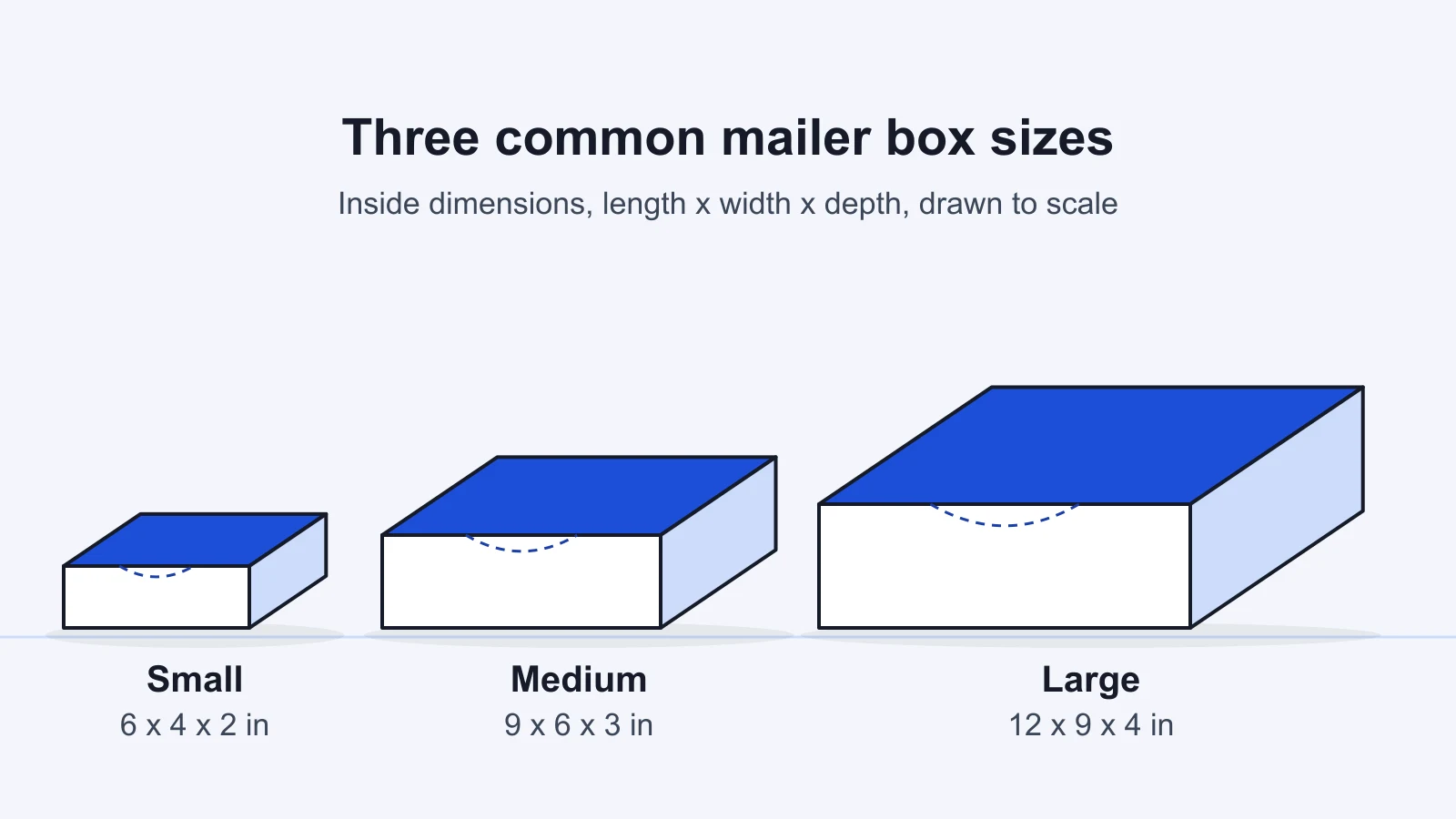

Custom mailer box sizes should start from your product, not from a size chart. Measure the thing going inside, add a little room, and make the box to those inside dimensions. As a first guess, a single small product like a candle or a skincare bottle fits around 6 x 4 x 2 inches, a two- or three-piece set or a folded tee around 9 x 6 x 3, and a subscription box around 12 x 9 x 4. The six sizes below each come with what usually fits and what it costs at 250, 500, and 1,000 boxes.
There isn't an official standard mailer size you have to pick from. Every custom mailer is cut from a flat sheet to your measurements, so the size is whatever your product needs. But a handful of sizes cover a lot of ground, and seeing them side by side with real prices makes the decision much easier.
Common custom mailer box sizes and what fits
Every size here is an inside measurement, written as length x width x depth. Inside is what matters, because it's the space your product actually gets.
| Size | Inside dimensions | Inside volume | What usually fits |
|---|---|---|---|
| Small | 6 x 4 x 2 in | 48 cu in | One skincare bottle, a candle, a phone case |
| Small wide | 8 x 6 x 2 in | 96 cu in | A flat lay of two or three small items |
| Medium | 9 x 6 x 3 in | 162 cu in | A two or three piece set, or folded apparel |
| Medium deep | 10 x 8 x 4 in | 320 cu in | A set with an insert, or three small candles |
| Large | 12 x 9 x 4 in | 432 cu in | A subscription box or a small hamper |
| Extra large | 14 x 10 x 4 in | 560 cu in | Bulkier apparel or a larger gift set |
If your product sits between two rows, you don't have to round up to the next one. You get the size in between. That's the whole point of a custom box.
What each size costs
These prices come straight from our estimator for a full colour mailer with no finish. You'll get the same numbers on the custom mailer boxes page if you type in the same dimensions.
| Size | 250 boxes | 500 boxes | 1,000 boxes |
|---|---|---|---|
| 6 x 4 x 2 in | $1.70 each | $1.20 each | $1.07 each |
| 8 x 6 x 2 in | $2.00 each | $1.41 each | $1.26 each |
| 9 x 6 x 3 in | $2.21 each | $1.57 each | $1.40 each |
| 10 x 8 x 4 in | $2.71 each | $1.92 each | $1.71 each |
| 12 x 9 x 4 in | $3.09 each | $2.18 each | $1.95 each |
| 14 x 10 x 4 in | $3.50 each | $2.47 each | $2.21 each |
Two things stand out. First, a bigger box costs more, but not in proportion. The 12 x 9 x 4 holds more than twice the space of the 9 x 6 x 3 and costs about 40% more at the same quantity. Second, quantity moves the price more than size does. The large box at 1,000 is cheaper each than the medium box at 250.
We price from the outside surface of the box, which is roughly how much board it takes, not from how much it holds. An extra inch of depth on a flat box costs less than you'd guess. An extra inch on every side adds up fast.
Which size for which product
Here's where we'd start for the kinds of products people commonly send in a mailer. Treat these as a first guess to measure against, not a rule.
Skincare and cosmetics. A single bottle or jar sits happily in a 6 x 4 x 2. A cleanser, serum and cream together usually wants the 9 x 6 x 3, often with a card insert so the bottles don't knock together. Our page on mailer boxes for cosmetics has more on what beauty brands order.
Candles. One candle in a jar or tin fits a small mailer, but check the depth with the lid on, because a candle is often taller than it is wide. For a set of three, the 10 x 8 x 4 with an insert is a sensible starting point. Glass needs cushioning room, so add the extra half inch per side. See mailer boxes for candles.
Apparel. A folded tee fits a 9 x 6 x 3, and a hoodie or a two item bundle is more comfortable in a 12 x 9 x 4 or 14 x 10 x 4. Soft goods don't fold perfectly flat, so leave closer to an inch rather than a quarter. More on mailer boxes for apparel.
Coffee. Bags vary a lot by brand, but a single 12 oz bag often fits a small wide 8 x 6 x 2 lying flat, or a 9 x 6 x 3 standing up. Two bags together are closer to a 10 x 8 x 4. Measure a filled bag, not an empty one. See mailer boxes for coffee.
Subscription boxes. These change every month, so size for the biggest month you've actually planned, not every possible product. The 12 x 9 x 4 is a reasonable start because it holds three or four mixed items with some tissue. More on subscription mailer boxes.
How to pick the right size
- Measure the product at its widest points. Take the longest, widest and deepest measurements, including any cap, pump, handle or bow. Use a ruler or calipers, not a guess from the product listing. Our guide to measuring a box properly goes through it step by step.
- Add the right amount of room. How much depends on what you're packing, shown just below.
- Count everything else that goes in. Tissue, a thank you card, a sample sachet, crinkle paper. Each one takes depth. If you're planning an insert, size the box around the insert rather than the bare product.
- Check it against a real sample. Numbers on paper are one thing. Your product sitting in real board is another.
How much room to add:
- Rigid products such as jars, bottles and electronics: about a quarter inch per side, so the item slides in and out without a fight.
- Soft goods such as folded apparel: closer to an inch, because fabric doesn't pack flat and a tight box crushes it.
- Fragile items that need cushioning: half an inch to an inch per side for tissue, paper fill or an insert.
Inside vs outside dimensions
This one is easy to get wrong on a first order. A mailer is made from E flute corrugated board, which is about a sixteenth of an inch thick. So the outside of the box is a little bigger than the inside on every side, and the lid adds a little more on top.
That sounds small. But if you give us outside numbers thinking they're inside numbers, your product won't fit, and a run of boxes that's a size too small can't be used at all. When you send us a size, always send the inside, and we'll work out the rest.
Why box size changes your shipping bill
Carriers don't only charge by weight. For bigger parcels they charge by dimensional weight, which is the length times width times height, divided by a fixed number. If that figure is higher than what the parcel actually weighs, you pay the higher one.
Here's a detail that matters for mailers. USPS only applies dimensional weight to packages over 1,728 cubic inches, which is one cubic foot, and from July 12, 2026 it divides by 139 and rounds every fraction of an inch up to the next whole inch. That's straight from the USPS notice on the change (opens in a new tab).
Now look at the sizes above. The largest, 14 x 10 x 4, is 560 cubic inches inside. Even with the board added, every size in this post is well under a cubic foot, so on USPS you pay for the actual weight. UPS and FedEx are different: they apply dimensional weight to every package, however small, and our post on dimensional weight and box size runs the numbers across carriers. If your product needs a shipper instead, our shipping box sizes chart shows which sizes stay under the USPS cubic price tiers.
Size still matters for the box itself. Going from 12 x 9 x 4 down to 10 x 8 x 4 saves about $0.26 a box at 500, before you count any shipping.
Mistakes that cost you money
- Sending outside dimensions. Covered above, and worth saying twice.
- Forgetting the insert. An insert takes up space on every side it touches. If you decide on one after the box is sized, the product may no longer fit. Decide first, then size the box around both.
- Measuring the product without its own packaging. A jar often goes into the mailer inside its own carton. Measure what actually goes in the box.
- Going too big. You pay for it three times: more board in the box, more tissue or paper fill to stop the product moving, and a bigger parcel that is closer to the size where carriers start charging for space. A box with lots of empty space also lets the product slide, and sliding is what breaks things in transit.
- Going too tight. The opposite mistake costs money too. If the product has to be forced in, packing takes longer, corners get crushed, and a glass jar has nothing between it and the wall of the box. A quarter inch per side for a rigid item is there for a reason.
- Running a different size for every product. If you sell three items of a similar size, one box that fits all three with a simple insert is usually cheaper than three separate runs. Fewer sizes means bigger quantities, and bigger quantities are where the price drops.
- Ordering before holding it. If you're unsure, order a sample pack and put your product next to real board before you commit.
Our pick for a first order
If you're launching one product and you're not sure, start from the medium, 9 x 6 x 3, and adjust it to your own measurements. It fits a lot of common first products, from a skincare set to a folded tee, and at 500 boxes it's $1.57 each.
Order 250 or 500 first, see how it works with your real product and your real courier, then adjust the size on the reorder if you need to. First orders often get something slightly wrong, and a small first run keeps that mistake cheap.
Key takeaways
- Custom mailer box sizes are made to your product's inside measurements. There's no standard size you're forced to pick.
- The six sizes here run from 6 x 4 x 2 to 14 x 10 x 4 inches.
- A 9 x 6 x 3 full colour mailer is $2.21 each at 250 and $1.57 at 500.
- Quantity moves the price more than size does.
- Always give inside dimensions, and add about a quarter inch per side for rigid products.
- All six sizes are under one cubic foot, where USPS starts charging dimensional weight.
Common questions
What size mailer box do I need?
Measure your product at its widest points, add about a quarter inch per side for a rigid item or up to an inch for soft goods, and use those as your inside dimensions. If you're between sizes, we cut the box to your exact numbers.
Can I order a size that isn't on this chart?
Yes. Every mailer is cut to your measurements, so the chart is a starting point, not a menu. Send us the inside length, width and depth.
Do I give you inside or outside dimensions?
Inside. That's the space your product gets. The board is about a sixteenth of an inch thick, so we work out the outside size from there.
Does a bigger box cost a lot more?
Less than you'd think. A 12 x 9 x 4 mailer costs about 40% more than a 9 x 6 x 3 at the same quantity, even though it holds more than twice as much.
What's the smallest order for a custom size?
100 boxes, the same minimum as every other mailer we make. A custom size doesn't change it.
Next step
Price your own size
Type your inside dimensions into the estimator and see the price at 250, 500 and 1,000, then send it for a free quote.
Open the estimatorThe boxes themselves
Formats this applies to
Every one of these is printed to your brand, starts at 100 units and comes with free design and a proof before anything goes on press.
Keep reading
More from the guides
Shipping
Custom packaging for Etsy sellers: when a printed box pays, and what it costs per order
Custom packaging for Etsy, worked out per order: when a printed mailer pays for itself, sizes that keep USPS postage low, and real prices from 100 boxes.
October 19, 2026 · 10 min
Artwork
Custom window boxes: where to cut the window, which film, and what it costs
Custom window boxes explained: where to cut the window, PET or PLA film, how to design artwork around it, and real prices from 100 boxes.
October 15, 2026 · 10 min
Materials
Custom bakery boxes: sizes, food safe board and real holiday prices
Custom bakery boxes sized for cupcakes, cookies, pies and cakes, with food safe board explained, real prices from 100 boxes and a Thanksgiving order timeline.
October 14, 2026 · 10 min
Want us to sanity check your box?
Rather just email? hello@boxcrisp.com