
Materials
ECT rating explained: 32 ECT vs 44 ECT and which box strength you need
September 28, 20269 min readWritten by the BoxCrisp team
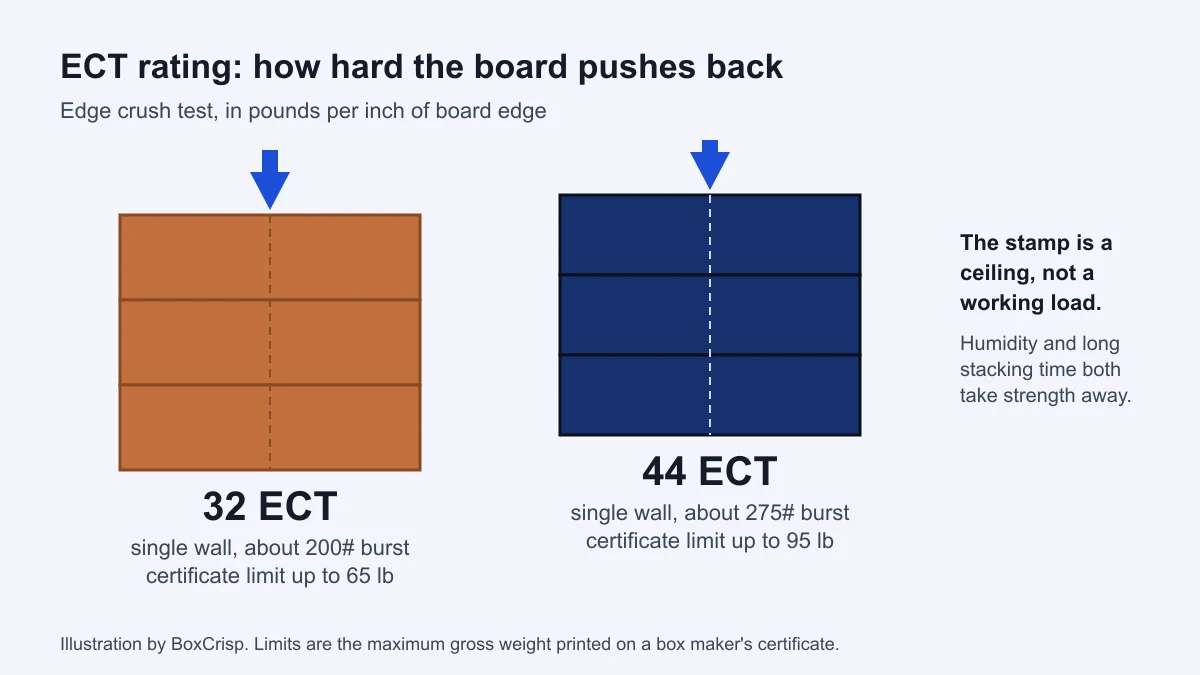

An ECT rating tells you how much pressure a corrugated box can take on its edge before the walls buckle, and for most online orders under about 40 pounds, a 32 ECT single-wall box is enough. Go to 44 ECT when the box is heavier, when it will sit at the bottom of a tall pallet stack, or when it will spend weeks in a humid warehouse. Everything below is about telling those cases apart, so you don't pay for board you don't need or lose product to board you skimped on.
What an ECT rating actually measures
ECT stands for edge crush test. A lab stands a small strip of corrugated board on its edge and presses down until it crushes. The number is the force it held, in pounds per inch of edge. So a 32 ECT board held 32 pounds on every inch of its edge before it gave way.
That matters because boxes fail from the top down. When boxes are stacked in a truck, a warehouse, or on a pallet, the bottom box carries everything above it through its four walls. The ECT rating is the best single number for predicting how long those walls hold.
ECT vs. burst test: the two numbers on the stamp
Flip a shipping box over, and you'll usually find a round stamp on a bottom flap. That's the box maker's certificate. It shows one of two ratings.
- ECT, in pounds per inch. This is about stacking strength.
- Burst test, also called the Mullen test, is written like 200#. A sheet is clamped and pushed from one side until it tears. This is about rough handling and punctures.
Neither is better. They measure different failures. An ECT-rated box usually uses a little less paper for the same stacking strength, which is why ECT has become the common rating for boxes that ship through parcel carriers.
32 ECT vs 44 ECT side by side
| 32 ECT | 44 ECT | |
|---|---|---|
| Rough burst equivalent | 200# | 275# |
| Certificate weight limit (box and contents) | Up to 65 lb | Up to 95 lb |
| A more conservative working load | About 40 lb | About 65 lb |
| Best at | Everyday parcels, apparel, cosmetics, small sets | Heavy items, glass in bulk, the bottom of a pallet |
| Typical construction | Single wall | Heavier single wall, or double wall |
The weight limits are the maximum gross weight printed on the box maker's certificate. Some box suppliers publish a lower working load for the same grade, such as 40 lb for 32 ECT, because a certificate limit assumes the box is in good condition and not stacked for weeks. We'd plan around the lower number.
The number on the stamp is a ceiling, not a target. A 32 ECT box is rated up to 65 lb, but a box packed to its limit and left at the bottom of a pallet in a damp warehouse is the one that fails.
What the carriers ask for
UPS asks for a minimum of a 200# burst or 32 ECT box for packages over 70 lb, and the box maker's certificate is how you check. You can read it in the UPS packaging guidelines (opens in a new tab). The same guide says a package tested and certified to ISTA Procedure 3A doesn't have to meet those minimums, because it has been proven another way.
Two things follow from that. First, 32 ECT is the floor for heavy parcels, not a premium choice. Second, the sizes printed on a certificate are about board strength, not about how the carrier measures your parcel for billing. Billing by size is dimensional weight, which we cover in how box size changes your shipping bill.
Which ECT rating do you need?
Start from the weight of the packed box, then adjust for how it travels.
- Weigh one packed box. Product, insert, tissue, and all. Use a kitchen or shipping scale, not the product listing.
- Under about 40 lb, going straight to a customer: 32 ECT is the normal choice.
- 40 to 65 lb, or anything that will be stacked high: move up to 44 ECT.
- Over 65 lb, or heavy and fragile together: ask about double wall.
- Headed to a warehouse or 3PL first: check their inbound rules. Some ask for a minimum rating on cartons they will stack.
A few examples to make it concrete:
- A folded hoodie in a mailer. A pound or two. Board strength isn't the problem here; presentation is. A custom mailer box in E flute is the right tool.
- Six candles in glass jars. Heavier than it looks, and glass needs the walls to stay square. 32 ECT with a divider insert is usually enough. The insert does more than a stronger board would; see our guide to box inserts.
- A case of coffee going to a café. Twelve bags add up fast, and the case may sit under others. This is where 44 ECT starts to earn its cost. See shipping boxes for coffee.
- Electronics with a small battery. Light, but expensive and fragile. A standard rating with a snug insert beats a heavy box with loose fill. More on shipping boxes for electronics.
Single wall vs double wall
Single wall board is one fluted layer between two flat liners. Double wall is two fluted layers and three liners. Double wall is stiffer, heavier, and takes a knock better, but it also adds weight to every parcel and takes up more room when the boxes arrive flat.
Our custom shipping boxes come in single or double wall. For most brands shipping direct to customers, a well-sized single-wall box is the better buy. Double wall is for weight, not for looks.
What changes the real strength of a box
The rating is measured in a lab on fresh board. A few things in the real world pull the number down.
- Humidity. Paper takes on moisture from the air and gets softer. A box that holds fine in a dry office can sag in a humid summer warehouse.
- Time under load. A stack that stands for a day is not the same as one that stands for a month. Long storage is a good reason to go up a grade.
- Overhang. If boxes hang over the edge of a pallet, the walls aren't sitting on anything and much of the strength is wasted. Line them up with the pallet edge.
- Cutouts. Handle holes and windows take board out of the walls. A large cutout near a corner is worth avoiding on anything heavy.
- Space. A box packed with room to spare has nothing inside supporting the walls. A right-sized box with the product filling it stacks better than a bigger, stronger box with air in it.
What it costs
A printed shipping box at 12 x 9 x 6 inches in full colour runs about $1.52 each at 250, $1.07 at 500, and $1.00 at 1,000 on our standard board. Those numbers come straight from our cost estimator. A heavier grade or double wall is priced on the quote because it depends on the size and how much board your box takes.
The honest advice is not to buy strength you can't name a reason for. If your packed box is 5 lb and goes straight to a doorstep, paying for 44 ECT buys nothing your customer will notice. If it's 45 lb and goes on a pallet, saving a few cents on 32 ECT is the kind of saving that shows up later as a damage claim.
Common mistakes with box strength
- Choosing the rating before weighing the box. Weigh first, then pick.
- Buying strength to fix a sizing problem. A box that's too big lets the product move, and a stronger box doesn't stop that. Measure properly first; our guide on how to measure a box walks through it.
- Ignoring the pallet. Parcels and pallets are different jobs. If the same box does both, choose the rating for the pallet.
- Assuming a mailer and a shipper are the same. They're built for different trips. Our comparison of mailer and shipping boxes covers when each one is right.
Our pick
If you're shipping direct to customers and the packed box weighs under about 40 lb, choose 32 ECT single wall and spend the money on a good fit and a proper insert instead. If you're shipping heavy cases, stacking on pallets, or storing for weeks, choose 44 ECT. If you can't decide, ask for a sample pack and put your real product in real board before you order a run.
Key takeaways
- An ECT rating is how many pounds per inch the board edge holds before it crushes.
- 32 ECT is the everyday standard and roughly matches a 200# burst box.
- 44 ECT roughly matches a 275# burst box and suits heavier or stacked loads.
- The certificate weight limit is a ceiling. Plan around a lower working load.
- UPS asks for at least 32 ECT or 200# burst for packages over 70 lb.
- Fit and inserts often protect a product more than a stronger board does.
Common questions
What does 32 ECT mean on a box?
It means a strip of the board held 32 pounds per inch of edge before it crushed in an edge crush test. It's the most common rating for single wall shipping boxes.
Is 44 ECT stronger than 32 ECT?
Yes. 44 ECT board holds more load on its edge, so the box stacks higher and carries more weight. Its certificate limit is up to 95 lb, compared to up to 65 lb for 32 ECT.
Is ECT the same as a 200# test box?
No, they're different tests. 200# is a burst test that measures resistance to tearing. 32 ECT is roughly the equivalent grade for stacking, which is why the two are often listed together.
Do I need 44 ECT for ecommerce?
Usually not. Most parcels going straight to a customer are light enough for 32 ECT. Move up when the packed box gets heavy, sits under other boxes, or waits a long time in storage.
Can you print on a 44 ECT or double wall box?
Yes. Our shipping boxes come in single- or double-wall and print the same way. Tell us the packed weight and how it ships, and we'll put the right board on the quote.
Next step
Tell us what the box has to carry
Send the packed weight and how it ships, and we will quote the right board for your custom shipping box.
Get a free quoteThe boxes themselves
Formats this applies to
Every one of these is printed to your brand, starts at 100 units and comes with free design and a proof before anything goes on press.
Keep reading
More from the guides
Shipping
Custom packaging for Etsy sellers: when a printed box pays, and what it costs per order
Custom packaging for Etsy, worked out per order: when a printed mailer pays for itself, sizes that keep USPS postage low, and real prices from 100 boxes.
October 19, 2026 · 10 min
Artwork
Custom window boxes: where to cut the window, which film, and what it costs
Custom window boxes explained: where to cut the window, PET or PLA film, how to design artwork around it, and real prices from 100 boxes.
October 15, 2026 · 10 min
Materials
Custom bakery boxes: sizes, food safe board and real holiday prices
Custom bakery boxes sized for cupcakes, cookies, pies and cakes, with food safe board explained, real prices from 100 boxes and a Thanksgiving order timeline.
October 14, 2026 · 10 min
Want us to sanity check your box?
Rather just email? hello@boxcrisp.com