
Choosing
Custom box inserts: what they cost, cardboard vs foam, and when you need one
September 23, 20266 min readWritten by the BoxCrisp team
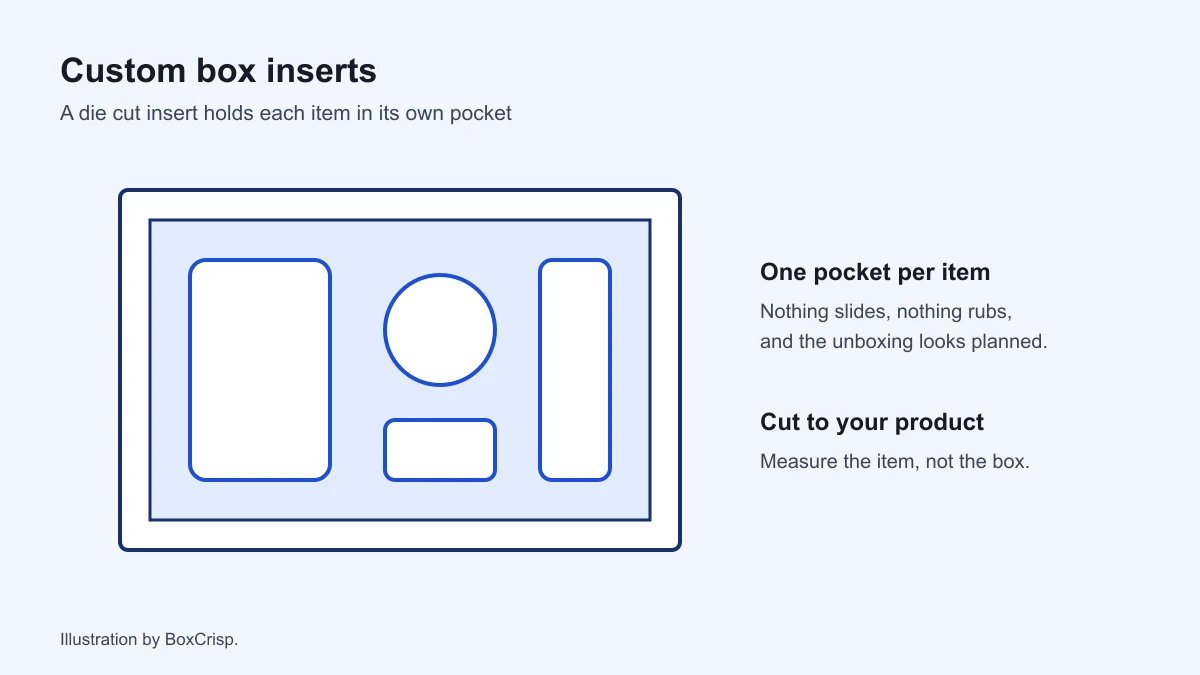

Custom box inserts are the pieces inside a box that hold your product still. If anything in your packed box can slide, tip, or clink, you want one, and it costs less than most people guess: about $1.39 each at 100 for a medium insert, $0.88 at 250, and $0.66 at 500.
We make them for candle brands, skincare sets, jewellery and small electronics. They share one problem: anything that can slide, tip or clink in transit arrives looking worse than it left, and crinkle paper alone rarely stops it.
What is a box insert?
It's a piece of board or foam cut to sit inside your box, with a well or slot for each item. It does two jobs. It stops things from moving on the way to your customer, and it decides what they see when they lift the lid.
The protection part is simple. A glass jar that can travel an inch inside the box hits the wall on every bump between our press and their porch. Hold it in a well, and the box takes the knock instead.
The presentation part is the one people underrate. Three bottles standing up in their own slots look like a set somebody chose. The same three bottles lying in a shred look like leftovers.
How much do custom box inserts cost?
Per insert, printed in one colour, which is the cheapest way we quote them. Your own size will land a little on either side.
| Insert size | 100 | 250 | 500 | 1,000 |
|---|---|---|---|---|
| Small, fits a 6 x 4 x 2 in box | $1.12 | $0.71 | $0.52 | $0.52 |
| Medium, fits a 9 x 6 x 3 in box | $1.39 | $0.88 | $0.66 | $0.66 |
| Large, fits a 12 x 9 x 4 in box | $2.02 | $1.28 | $0.95 | $0.95 |
Look at the last two columns. They're the same. The cutting die is a one-time cost that spreads thinner as the run grows, and past about 500 all that's left is board and press time. So if a supplier tells you to order 1,000 inserts to get the price down, ask to see the 500 price first. You can move the quantity yourself on our cost estimator and watch where it flattens.
Cardboard inserts for boxes vs custom foam inserts
Cardboard (corrugated). The same fluted board as a shipping box, cut into walls and wells. This is what we'd pick for most products. It's strong, it's light, and your customer can throw it in the recycling with the box.
Paperboard. Thinner and smoother, the stuff cereal boxes are made of. It prints cleanly and looks neat under a lid, so it suits cosmetics, jewellery and light gift sets, and it's what we'd put inside a rigid gift box. Don't trust it with heavy glass.
Foam. Cut to the exact outline of the product. It earns its price around electronics, glass bottles and anything where one breakage costs more than the whole insert run. It's also the hardest one to recycle. The EPA's packaging figures (opens in a new tab) show how far paper and board recycling runs ahead of plastics in the US, so don't choose foam just because it feels premium. Our guide to eco friendly packaging goes further into what your customer can actually recycle.
Molded pulp. Pressed from recycled paper fibre. It protects well and reads as low waste, but the shape needs its own mould, so it only makes sense on a product you'll be shipping for years.
Not sure? Start with cardboard. For a first order of inserts, that is usually all you need.
Custom mailer boxes with inserts
It's a common pairing, and a sensible one. A mailer box is sturdy enough to ship on its own, looks good when it's opened, and a cardboard insert inside it turns a loose product into a kit.
The mistake to avoid is sizing the two separately. If you order the mailer first and ask for an insert later, the insert has to fit a box that was never planned around it, and you end up with gaps or a squeeze. If you're still deciding between a mailer and a plain shipper, our comparison walks through the trade off. Give us the product measurements, and we'll size the box and the insert together, from the same numbers.
When you don't need an insert at all
Soft goods don't. A t-shirt, a scarf, or a bag of coffee travels fine in a mailer cut close to its size, and tissue paper handles the presentation for a few cents.
A single sturdy item in a box that fits it snugly usually doesn't either. The cheapest insert is a box that's the right size in the first place, which is why measuring your product properly comes before anything else.
Common insert styles
Most inserts are one of four shapes, and knowing the names makes the conversation quicker.
Tray with wells. A flat panel with cut outs, one per item, so each piece drops into its own space. This is the one people picture when they hear "insert", and it suits sets of jars, bottles and tins.
Dividers. Strips of board that slot together into a grid, like the partitions in a wine carton. They're simple, cheap to cut, and good for several items of the same size.
Platform or riser. A raised shelf that lifts one product toward the lid, with the space underneath left empty or used for a card. It's the easiest way to make a single item look like the point of the box.
Wrap or cradle. A folded piece that holds the product from below and at the sides. It works for one awkward shape, like a candle with a wooden lid or a phone accessory.
If you can't tell which one you need, describe the product and how you'd like it to sit. The shape usually picks itself from there.
How to order custom box inserts
- Measure every piece. Length, width, and height of each item, plus anything that ships with it, like a thank-you card or a sample.
- Tell us the box. Name the box you already use, or let us size one around the insert. Our mailer box size chart is a good place to start. Our box inserts page shows the common sizes and prices.
- Say how it should look opened. Upright, lying flat, one hero product with smaller pieces around it. A phone photo of how you'd lay it out on a table beats a paragraph.
- Test it as a carrier would. Pack one, then shake it and drop it. Shippers who need a formal answer use the published ISTA test procedures (opens in a new tab), but for most small brands, a few drops from waist height tell you enough.
- Feel the board first. Our free sample pack puts the boards and finishes in your hand, which is better than any photo.
Production is 3 to 5 days once you approve the proof, plus shipping. The minimum is 100.
Custom box inserts near me?
We don't run a local shop, and we won't pretend to. What we do is make inserts and the boxes they go in for brands across the lower 48, with production in 3 to 5 days and the insert designed alongside the box for free. For most people searching for a local supplier, what they actually want is somebody who answers quickly and gets the fit right the first time. That part we can do from anywhere.
Key takeaways
- A custom box insert holds your product still, so nothing slides, tips or clinks in transit.
- A medium insert is about $1.39 each at 100, $0.88 at 250 and $0.66 at 500.
- Size the insert and the box together, never one after the other.
- Soft goods, and a single item in a snug box, often need no insert at all.
- The minimum is 100, the same as our boxes.
Common questions
What is a custom box insert?
It's a piece of board or foam cut to sit inside your box and hold the product in place, usually in its own well or slot. It stops things from moving in transit and makes the box look organised when it's opened.
How much do custom inserts cost?
About $1.39 each at 100 for a medium insert, $0.88 at 250, and $0.66 at 500, printed in one colour. Small ones cost less and large ones more. The price stops falling around 500.
Are cardboard or foam inserts better?
Cardboard for most products, because it's strong, light, and recyclable. Foam for electronics, glass, and anything expensive enough that one breakage costs more than the whole run.
What's the minimum order for custom box inserts?
100, the same as our boxes. It makes sense to order the inserts in the same run as the box, since both are cut from the same measurements.
Can the insert be printed?
Yes, in one colour or full colour, with a matte finish if you want one. Most stay plain, though. The box does the branding, and the insert does the holding.
Next step
Price your insert in seconds
Pick box inserts, set a size and a quantity, and see the price move. No account, no card.
Price a box insertThe boxes themselves
Formats this applies to
Every one of these is printed to your brand, starts at 100 units and comes with free design and a proof before anything goes on press.
Keep reading
More from the guides
Artwork
Custom window boxes: where to cut the window, which film, and what it costs
Custom window boxes explained: where to cut the window, PET or PLA film, how to design artwork around it, and real prices from 100 boxes.
October 15, 2026 · 10 min
Materials
Custom bakery boxes: sizes, food safe board and real holiday prices
Custom bakery boxes sized for cupcakes, cookies, pies and cakes, with food safe board explained, real prices from 100 boxes and a Thanksgiving order timeline.
October 14, 2026 · 10 min
Sizing
Shipping box sizes: a size chart built around USPS price tiers
Shipping box sizes that land under USPS cubic price lines, with inside and outside inches, real prices from 100 boxes, and the quarter inch that moves a tier.
October 13, 2026 · 9 min
Want us to sanity check your box?
Rather just email? hello@boxcrisp.com