
Shipping
Packaging drop test: how to check your box at home before you order a full run
November 6, 202610 min readWritten by BoxCrisp team
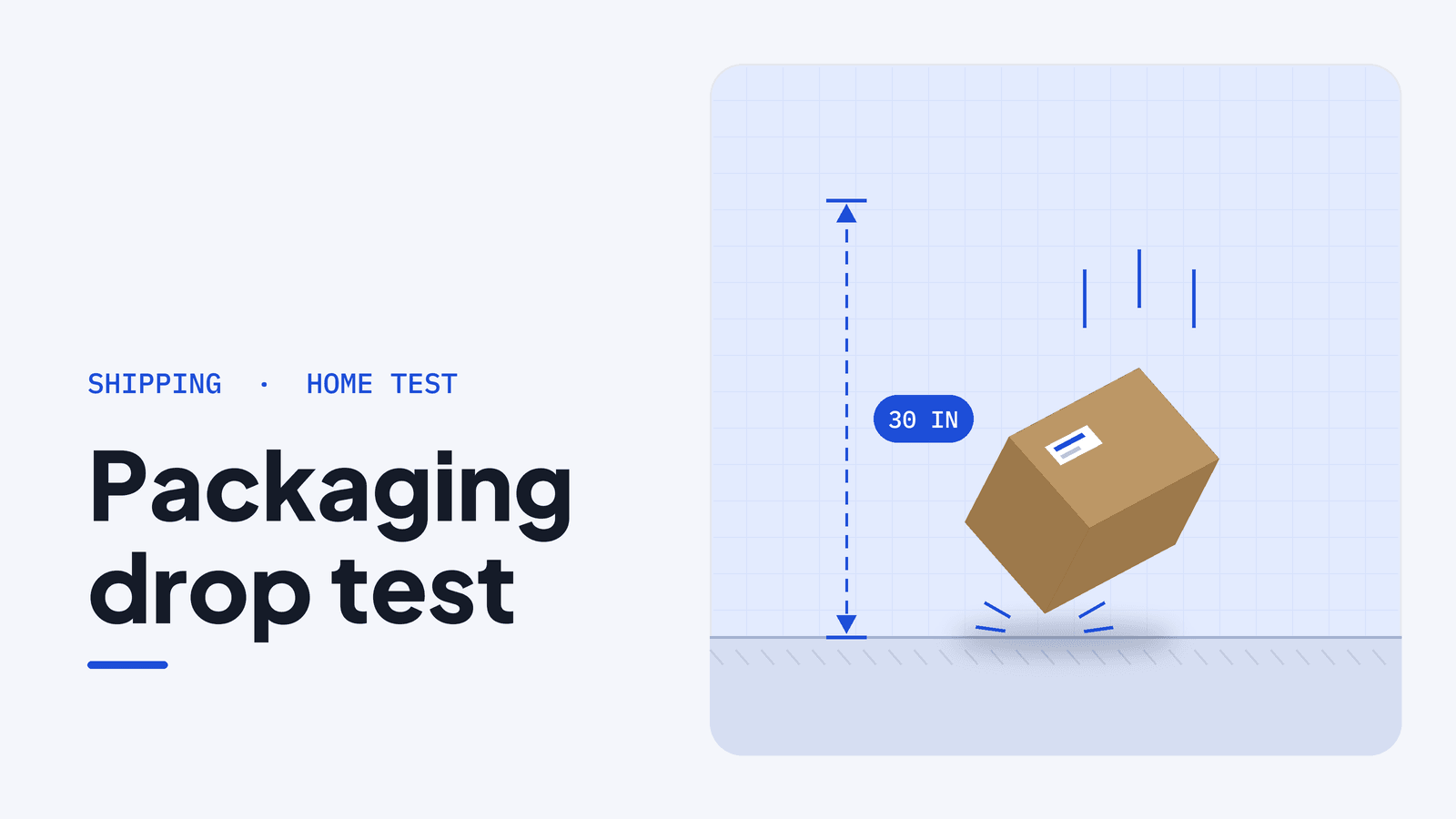

A packaging drop test is the cheapest way to find out whether your box will protect your product before you pay for a full run. You pack one real order, drop it from a set height onto a hard floor in a set order, then open it and look. It takes about twenty minutes, a tape measure and a phone camera. It tells you more about your box than any spec sheet does.
Most damage in the mail comes from small moments: a parcel sliding off a conveyor, landing on a corner, tipping off a porch step. A home packaging drop test copies those moments on purpose, so you see the dent in your kitchen instead of in a one-star review.
What a packaging drop test tells you
A packaging drop test answers one question: do the box and everything inside it keep the product safe when it lands badly? The box, the insert, the fill, the tape and the product all fail or survive together.
It shows you:
- Whether the product moves inside the box. Movement is the biggest cause of breakage.
- Whether the corners crush and let the product hit the floor through the wall.
- Whether the insert holds its shape or collapses on the first hard landing.
- Whether the flaps or tuck closure pop open.
What it can't show you is long-term stacking strength or how the box behaves after a week in a humid warehouse. Those are about board grade, which our guide to ECT ratings covers. Think of the drop as the test for the trip, and the ECT rating as the test for the stack.
What you need
- One finished order. The real product, the real insert, tissue, cards, everything a customer gets. A test with a stand-in product tells you about the stand-in.
- The box you plan to buy. A box from a sample pack, a short first run, or a paper mock-up from a printed dieline for a first fit check.
- A hard floor. Concrete is best. A garage floor or a tiled floor over a slab works. Carpet and wood floors soften the landing and flatter the box.
- A scale, a tape measure, a marker and a phone. Weigh the parcel, mark the drop height on a wall, number the faces and film each drop.
If you don't have the box yet, start with a paper version. Our dieline generator lets you put in your dimensions, print at 100 percent and fold the box out of paper. It won't survive a drop, but it tells you whether the product and insert fit before you test the real board.
How high to drop the box
The most widely used reference for a basic packaging drop test is ISTA Procedure 1A from the International Safe Transit Association. It sets the drop height by the weight of the packed parcel. The lighter the box, the higher the drop, because light parcels get thrown and tossed more than heavy ones.
The heights in ISTA 1A, measured from the lowest point of the box to the floor:
- Under 21 lb: 30 inches
- 21 to 41 lb: 24 inches
- 41 to 61 lb: 18 inches
- 61 to 100 lb: 12 inches
- 100 to 150 lb: 8 inches
Most direct-to-customer orders land in the first band, so 30 inches is the number to tape on your wall. That's a little below kitchen-counter height.
The full procedures, including the official equipment and reporting rules, are published on the ISTA test procedures page (opens in a new tab). A home test is not a certified test, but using the same heights and order keeps your result honest.
The ten-drop sequence
A lab works through one corner, three edges and six faces, in order. You can run the same packaging drop test sequence at home.
Before you start, number the faces of the box. Call the top 1, then the right side 2, the bottom 3, the left side 4, the front 5 and the back 6. Pick the corner where faces 2, 3 and 5 meet. That's usually the weakest corner, because it sits next to the manufacturer's joint or the tuck closure.
- Drop it on that corner, so it lands point first.
- Drop it on the shortest edge that runs from that corner.
- Drop it on the next shortest edge from that corner.
- Drop it on the longest edge from that corner.
- Drop it flat on one of the smallest faces.
- Drop it flat on the opposite smallest face.
- Drop it flat on one of the medium faces.
- Drop it flat on the opposite medium face.
- Drop it flat on one of the largest faces.
- Drop it flat on the opposite largest face.
Hold the box so the part you're testing points at the floor, then let go. Don't throw it or guide it down. Slow-motion video shows which way the product shifted inside.
What counts as a pass
Open the box after the tenth drop, not between drops.
A packaging drop test is a pass when:
- The product is undamaged and works. No chips, cracks, leaks, bent parts or loose caps. Switch electronics on. Unscrew and check lids on jars and bottles.
- The product is where you put it. It may have shifted slightly, but it hasn't punched into a wall or jumped out of the insert.
- The box still closes. Corners may be scuffed or a little rounded. The walls shouldn't be split, and the flaps shouldn't be open.
- It would look fine on a doorstep. Be honest. If you'd be embarrassed to hand it to a customer, call it a fail even if the product survived.
Run the packaging drop test on at least two packed boxes. One good result can be luck.
Three more tests worth five minutes
The drops cover most of the trip, but three quick checks catch the rest.
The shake test
Shake the closed box hard for ten seconds. If you hear anything move, it will move in a truck for hours. Fix that first.
The stack test
Stack weight on the packed box for a day, roughly three or four parcels' worth. If the top caves in or the walls bow out, the board grade or the fit is wrong.
The mail-it-to-yourself test
Ship one packed box to a friend in another state and have them send it back unopened. It's the only test with real conveyors, sorting and weather, and it costs two labels.
Worked example: a ceramic studio's four-mug set
Say you run a small ceramics studio and you're launching a gift set of four stoneware mugs. Each mug weighs about 14 ounces. You plan to ship the set in a printed 12 x 9 x 6 inch custom shipping box. In full color, that box is about $1.52 each at 250 in our cost estimator.
Here's how the studio's packaging drop test goes:
- Weigh it. Four mugs, crinkle paper and a card come to about 4.5 lb packed. That's under 21 lb, so the drop height is 30 inches.
- First pack: mugs wrapped in tissue, crinkle paper around them. The shake test rattles. After the ten drops, one handle has snapped off, because the mugs knocked into each other on the edge drops.
- Second pack: a divider insert with four cells. No rattle. After ten drops, all four mugs are fine, but the corner from drop one is crushed by about half an inch.
- Third pack: the same insert, mugs set half an inch in from every wall. Ten drops, no damage, corners only scuffed. Repeated on a second box with the same result.
The fix wasn't a heavier board. It was an insert and a little space around the product, the most common outcome of a home packaging drop test. Our box insert guide compares the insert styles that do this job.
Now the studio can order 250 boxes knowing the pack works.
What to change when the box fails
Read the damage, then change one thing at a time and test again.
- Product broke against another product. Add dividers or a fitted insert so items can't touch. Custom box inserts hold each piece in its own place.
- Product hit the wall on a corner or edge drop. Leave half an inch to an inch of padding between the product and the walls. Size the box from the packed insert, not the bare product. Our guide on how to measure a box shows how.
- The corner crushed but the product survived. That's often fine for one drop, but check the stack test. If the walls bow, move up a board grade.
- The flaps or tuck opened. Tape differently, add a strip across the seam, or switch to a closure that locks.
- A mailer split along a fold. A mailer is built for a lighter trip than a shipping box. Our comparison of mailers and shipping boxes explains when to switch.
Resist the urge to fix a sizing problem with a bigger box. An oversized box costs more to ship on every order, as our post on dimensional weight explains, and it gives the product more room to move.
When you need a certified lab test
A home packaging drop test is for your own confidence. Some buyers want paperwork instead.
- Amazon. Amazon's Ships in Product Packaging program (opens in a new tab) lets some sellers test their own packaging for products under 50 lb without liquids or sharp items. Everything else goes to an ISTA lab. Check the current rules in Seller Central, because they change.
- Heavy parcels with UPS. The UPS packaging guidelines (opens in a new tab) set minimum board grades for heavier packages. A package certified to ISTA Procedure 3A is exempt from those minimums, because it has been tested another way.
- Retail and wholesale buyers. Some big-box retailers and distributors name an ISTA procedure in their vendor manual. If yours does, a home test won't count.
For most small brands shipping direct to customers, a careful home test on two or three boxes is enough.
Our pick
Run the ten drops at the ISTA 1A height on two fully packed boxes before your first full order. Add the shake test and one mail-it-to-yourself parcel. If the box fails, fix the insert and the fit before you pay for heavier board. Then order the smallest run that lets you sell through in a few months, and test again whenever the product, the insert or the box size changes.
If you'd like a second opinion on what the damage means, send us the details with a photo of the failed box. We'll tell you whether it's a fit problem, an insert problem or a board problem.
Key takeaways
- A packaging drop test checks the whole pack: box, insert, fill, tape and product together.
- ISTA 1A sets the drop height by packed weight. Under 21 lb, drop from 30 inches.
- The sequence is one corner, three edges and six faces, ten drops in all, onto a hard floor.
- Open the box only after the last drop, and test at least two boxes.
- Most failures are fixed with an insert and better fit, not stronger board.
- Amazon, UPS for heavy parcels, and some retailers may ask for a certified lab test instead.
Common questions
How do you drop test a box at home?
Pack one real order, weigh it and mark the packaging drop test height on a wall. For a parcel under 21 lb that's 30 inches. Drop it onto concrete on one corner, three edges and six faces, then open it and inspect the product and the box.
What height should a packaging drop test be?
ISTA 1A uses 30 inches for packages under 21 lb and 24 inches up to 41 lb. Heavier parcels drop from 18, 12 or 8 inches. Measure from the lowest point of the box to the floor.
Is a home drop test the same as ISTA certification?
No. Certification needs an ISTA-certified lab, set equipment and a formal report. A home test uses the same heights and order, so it's a good guide, but it won't satisfy a buyer who asks for a certificate.
How many boxes should I test?
Run each packaging drop test on at least two boxes, packed exactly as a customer would receive them. If the results differ, test a third. Retest whenever the product, insert or box size changes.
Does a stronger box fix drop damage?
Sometimes, but not usually first. Most drop damage comes from the product moving inside the box. A fitted insert and the right amount of space around the product fix more failures than a heavier board does.
The boxes themselves
Formats this applies to
Every one of these is printed to your brand, starts at 100 units and comes with free design and a proof before anything goes on press.
Keep reading
More from the guides
Artwork
How to check a packaging proof before you approve it
A packaging proof checklist for your box design: size, text, logo, folds, barcodes, color, finish and the label area, checked panel by panel before print.
November 5, 2026 · 15 min
Sizing
Custom boxes with lids: four lid styles, how to size the lid, and what each one costs
Custom boxes with lids, compared: tuck top, two-piece lift-off, hinged rigid and sleeve. How deep the lid should sit, how it should fit, and prices from 100.
October 27, 2026 · 10 min
Choosing
Custom jewelry boxes: three sizes that cover a whole range, the insert that matters, and real prices
Custom jewelry boxes for small brands: three sizes that cover rings, earrings and necklaces, why the insert matters, how to ship them, and real prices from 100.
October 26, 2026 · 9 min
Want us to sanity check your box?
Rather just email? hello@boxcrisp.com