
Choosing
Types of folding cartons: which closure to pick, and why it matters
October 1, 20269 min readWritten by the BoxCrisp team
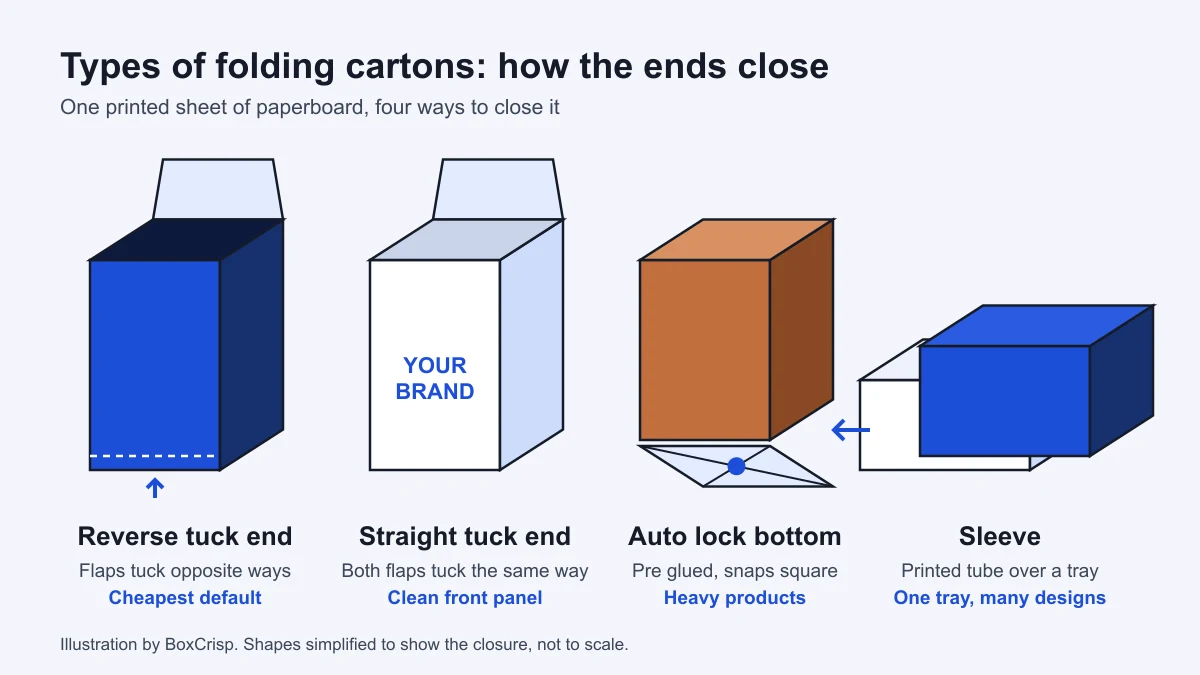

There are five types of folding cartons worth knowing as a buyer: the reverse tuck end, the straight tuck end, the auto lock bottom, the snap lock bottom, and the sleeve. They're all cut from one printed sheet of paperboard and shipped flat. What separates them is how the ends close, and that decides how much weight the carton holds, how fast you can pack it, and which face your customer sees first.
If you only remember one thing: a reverse tuck end is the cheap, sensible default for anything light, and an auto lock bottom is the upgrade once the product is heavy or you're packing hundreds by hand.
What is a folding carton?
A folding carton is a box made from a single sheet of paperboard, often called chipboard, not corrugated board. It gets printed flat, coated if you want a finish, die-cut, creased, and glued along one seam. It arrives at your door folded flat, and you pop it into shape when you pack.
That's the difference from a mailer box, which is corrugated and made to survive a courier on its own. A folding carton is a retail box. It sits on a shelf, or it goes inside a shipper. Post one on its own, and it'll arrive dented, which is the most common mistake people make with them.
The industry has a shared catalogue of these constructions. The European Carton Makers Association published its first set of standard folding box designs in 1967, and printers still use ECMA style codes (opens in a new tab) to describe a carton without drawing it. You don't need the codes. You do need the names below, because they're what a printer will ask you for.
The main types of folding cartons
Reverse tuck end
The top flap tucks in from the back and the bottom flap tucks in from the front, so the two closures face opposite ways. It's the most common carton on a pharmacy or cosmetics shelf, and for good reason. Opposite tucks let the sheet nest tightly on the press, so it wastes less board, and that keeps it cheap.
Good for: serums, supplements, lip products, anything under about a pound.
The catch: the bottom tuck sits on the front edge, so one closure edge shows on your display face.
Straight tuck end
Both flaps tuck in from the same side, front to back, top and bottom. The closure edges stay off the front panel, so your artwork runs clean edge to edge. People who care about how the front looks on a shelf pick this one.
It uses a little more board than a reverse tuck, because the sheet doesn't nest as tightly. On a short run, the difference is small. On tens of thousands, it adds up.
Good for: premium cosmetics, a hero product where the front face is the whole sell. When a printer quotes custom printed tuck boxes, they mean either this style or the reverse tuck above.
Auto lock bottom (also called crash lock)
The bottom is pre-glued at the factory. When you open the flat carton, the base snaps square on its own and locks. The top still closes with a tuck flap.
Two things make it worth paying for. It holds far more weight than a tuck flap, which can push open under a heavy jar. And it's quick to pack, because there's no bottom to fold. If someone on your team is packing three hundred cartons on a Sunday, this is the one they'll thank you for.
Good for: candle jars, glass bottles, coffee bags, anything heavy or anything packed in volume.
The catch: the extra glue points mean an extra step on the gluing line, so it costs a little more per box. We price it on the quote rather than in the estimator.
Snap lock bottom (also called 1-2-3 bottom)
Four flaps on the base fold in a set order and interlock without glue. It holds more than a tuck end and less than an auto lock, and it takes a few seconds longer to assemble by hand.
Good for: medium-weight products on a budget, when you're packing small numbers and don't mind the extra fold.
Sleeve
A printed tube that slides over a tray or another box. It isn't strictly a carton with closures, but it comes off the same press and the same board, so it belongs on this list. A sleeve lets you print one plain inner box once and change the outside for each product or season. We make them as sleeve boxes.
Two more you'll meet in food.
Food adds two more types of folding carton packaging, because what's inside is fragile or greasy and nobody wants glue near it.
- Gable top. A carton with a built-in carry handle, folded up from the sides. Takeaway, bakery gifts and party favours. See our gable boxes.
- Bakery box. A wide, shallow carton that locks at the corners without glue on the inside faces, often with a window. It holds a decorated cake without touching it. See our bakery boxes, or our guide to custom bakery boxes for sizes by pan and food safe board.
Different folding carton styles compared
| Style | Holds weight | Packing speed | Front panel | Relative cost |
|---|---|---|---|---|
| Reverse tuck end | Light | Medium | One edge shows | Lowest |
| Straight tuck end | Light | Medium | Clean | A little more board |
| Snap lock bottom | Medium | Slowest | Clean base | Middle |
| Auto lock bottom | Heavy | Fastest | Clean base | Highest of the four |
| Sleeve | Depends on the tray | Fast | Fully printable | Depends on the tray |
What a folding carton costs
These are the prices our own estimator gives for a medium folding carton, 3 x 3 x 6 inches or close to it, per box, before shipping and tax. The tuck style doesn't change the estimate. An auto-lock bottom adds a little to the quote.
| Quantity | One colour | Full colour | Full colour, soft touch |
|---|---|---|---|
| 100 | $1.80 | $2.20 | $2.68 |
| 250 | $1.14 | $1.39 | $1.70 |
| 500 | $0.86 | $1.05 | $1.28 |
| 1,000 | $0.86 | $1.05 | $1.28 |
Notice the price stops falling at 500. That's the floor: past it you're paying for board and ink, which don't get cheaper with volume. So don't order a thousand just to chase a lower unit price that isn't there.
Callout: A finish on a folding carton buys more than it does on almost any other box. Soft touch on a full colour carton adds about 23 cents at 500, and on a small shelf box that's the difference between looking like a pharmacy product and looking like a brand.
Which type of folding carton should you pick?
Here's the order we'd work through it.
- Weigh the product. If it's glass, a jar, or anything that rattles, go straight to an auto-lock bottom. A tuck flap under a heavy jar is how a customer ends up holding the box while the product falls out.
- Count how many you pack at once. Hundreds by hand at a time also points to auto lock. Fifty a week and a reverse tuck is fine.
- Look at the front. If the front panel is the whole sell and you want nothing cutting through it, pick a straight tuck.
- Otherwise, take the reverse tuck. It's the default for a reason, and it's the cheapest.
- Plan the ship box too. A carton goes inside something. If you're selling online, budget for a custom box insert or a shipper around it.
The mistakes that cost a reprint
Measuring the product, not the product in its carton. A folding carton is cut tight. Leave about a sixteenth of an inch on each side for a bottle, more for anything with a pump or a cap that sticks out.
Putting key text across a flap. Text that crosses a crease or a tuck ends up folded in half or hidden. Ask for the dieline first and keep copy inside the safe zone. Our guide on what a dieline is shows where those lines fall, and you can draw one for free with our dieline generator.
Expect screen colour on uncoated board. Colour shifts on paperboard, and more on kraft. If a brand colour has to match, read our piece on CMYK vs Pantone before you send artwork.
Shipping cartons on their own. We said it above, and it's worth saying twice. A folding carton isn't a shipper.
Our pick
For most small brands, a reverse tuck end in full colour with a matte finish is the sweet spot. It's cheap, it looks finished, and it's what a store buyer expects. Move to an auto-lock bottom the moment the product is heavy. Skip foil on your first run, because you'll want to see the carton on a shelf before paying for metallic.
If you're selling supplements, see what we'd suggest on our page for folding cartons for supplements. And if you want to hold real board before deciding, ask for a sample pack.
Key takeaways
- The five types of folding cartons buyers meet most are reverse tuck, straight tuck, auto lock bottom, snap lock bottom, and sleeve.
- Reverse tuck is the cheapest default. Straight tuck keeps the front clean.
- Auto lock bottoms hold heavy products and pack fastest, and cost a little more.
- A medium folding carton in full colour runs about $1.39 at 250 and $1.05 at 500.
- A folding carton is a retail box, not a shipper.
Common questions
What are the main types of folding cartons?
Reverse tuck end, straight tuck end, auto lock (crash lock) bottom, snap lock (1-2-3) bottom, and sleeves. Food adds gable tops and bakery boxes. They differ mainly in how the ends close.
What is the difference between reverse tuck and straight tuck?
On a reverse tuck, the top and bottom flaps tuck from opposite sides. On a straight tuck, both tuck from the same side, which keeps closure edges off the front panel but uses slightly more board.
Is an auto lock bottom worth the extra cost?
Yes, if the product is heavy or you pack a lot by hand. The base locks itself when opened, holds far more weight than a tuck flap, and saves a fold on every box.
Can a folding carton be shipped on its own?
Not safely. Paperboard isn't corrugated and dents in a courier network. Put the carton inside a mailer or shipping box.
How much do custom folding cartons cost?
A medium full colour folding carton from us is about $2.20 each at 100, $1.39 at 250, and $1.05 at 500, before shipping and tax.
Next step
Price a folding carton
Pick a size, print and finish and see the unit price from 100 boxes. No account, no card.
Open the estimatorThe boxes themselves
Formats this applies to
Every one of these is printed to your brand, starts at 100 units and comes with free design and a proof before anything goes on press.
Keep reading
More from the guides
Artwork
Custom window boxes: where to cut the window, which film, and what it costs
Custom window boxes explained: where to cut the window, PET or PLA film, how to design artwork around it, and real prices from 100 boxes.
October 15, 2026 · 10 min
Materials
Custom bakery boxes: sizes, food safe board and real holiday prices
Custom bakery boxes sized for cupcakes, cookies, pies and cakes, with food safe board explained, real prices from 100 boxes and a Thanksgiving order timeline.
October 14, 2026 · 10 min
Sizing
Shipping box sizes: a size chart built around USPS price tiers
Shipping box sizes that land under USPS cubic price lines, with inside and outside inches, real prices from 100 boxes, and the quarter inch that moves a tier.
October 13, 2026 · 9 min
Want us to sanity check your box?
Rather just email? hello@boxcrisp.com